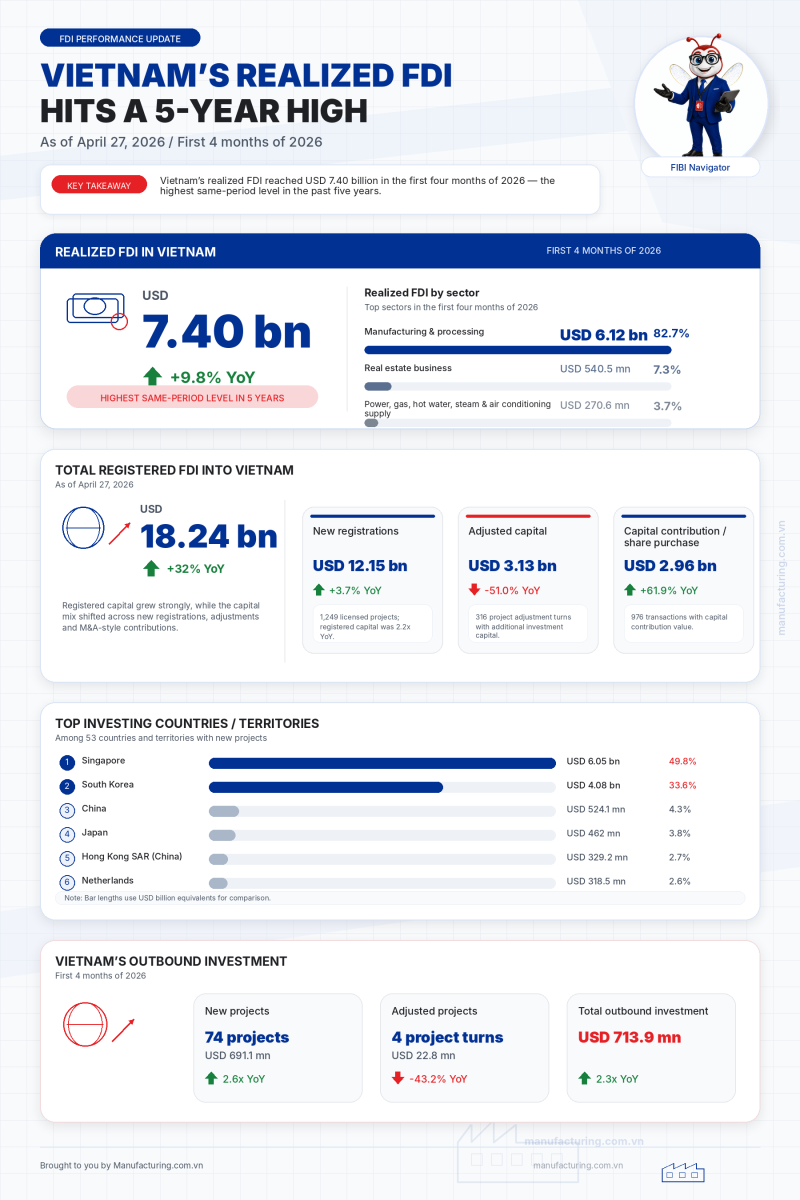
Vietnam is moving from a low-cost assembly base into a higher-value manufacturing hub in Asia. In the first four months of 2026, the country attracted US$18.24 billion in FDI, with manufacturing and processing accounting for the largest share of new capital and disbursements.
For global manufacturers, Vietnam is no longer only a China+1 option. It is becoming a market where companies must think carefully about location strategy, automation, supply-chain integration, ESG compliance, and long-term industrial capacity.
Vietnam’s manufacturing appeal is built on four connected advantages: strategic location, competitive operating costs, policy stability, and an improving workforce. With more than 3,200 km of coastline and major ports from Hai Phong to Da Nang and Ba Ria-Vung Tau, Vietnam offers direct access to key shipping routes and export corridors.
The country’s FTA network, including CPTPP, EVFTA, RCEP, and UKVFTA, gives manufacturers preferential access to markets across Europe, Asia, and the Pacific. These agreements also push Vietnam to improve customs procedures, intellectual property protection, labor standards, and sustainability practices.
Cost competitiveness remains important, but Vietnam’s advantage is no longer limited to wages. Labor costs are still lower than in China and many ASEAN peers, while industrial land, utilities, logistics, tax incentives, ready-built factories, and digital infrastructure are becoming part of the broader cost equation.
The 2026 incentive framework includes a standard corporate income tax rate of 20 percent, preferential rates of 10–15 percent for eligible high-tech or green projects for up to 15 years, up to four years of CIT exemption, a 50 percent reduction for nine years, import-duty exemptions, and land-rent exemptions of 7–15 years in industrial zones.
| Incentive Type | Details |
| Corporate Income Tax (CIT) | Standard rate: 20%, preferential 10–15% for high-tech or green projects for up to 15 years. |
| Tax Holidays | Up to 4 years CIT exemption, followed by 50% reduction for 9 years for eligible projects. |
| Import Duty Exemptions | For machinery, raw materials, and components used in export or R&D activities. |
| Land Lease Incentives | 7–15 years rent exemption in industrial zones; longer for underdeveloped regions. |
| Industrial Park Support | Ready-built facilities, shared logistics, and one-stop licensing services. |
| Green & ESG Incentives (2025) | Additional tax reductions or fast-track licensing for sustainable or renewable-energy projects. |
Vietnam also has a large labor base. In 2024, the labor force aged 15 and above reached about 52.5 million people, with labor participation near 69 percent. More than 28 percent of workers held formal training certificates or degrees. As of 2023, vocational and intermediate education enrolled more than 2.2 million students, including 530,000 at college or intermediate level and more than 1.7 million in vocational programs.
Infrastructure development is reinforcing Vietnam’s manufacturing position. Quang Ninh planned four new industrial parks in 2025. Hai Phong allocated nearly VND 8,000 billion for infrastructure linked to Thuy Nguyen and Tien Lang Airport industrial parks. Hung Yen targets 5–8 new industrial parks in 2026 with more than 1,000 ha cleared. Ho Chi Minh City is planning 14 modern industrial parks covering more than 3,800 ha, with eight targeted for 2026.
Electronics and electrical equipment remain Vietnam’s largest manufacturing and export segment. In 2024, electronics contributed more than 30 percent of total exports, equal to over US$72.6 billion in shipments. Samsung, LG, Foxconn, Pegatron, BOE Technology, and Intel have built major bases in Bac Ninh, Hai Phong, and Thai Nguyen. Vietnam is now trying to move from final assembly into printed circuit boards, sensors, optical components, and semiconductors. The government also targets training 50,000 semiconductor engineers by 2030.
Textiles, garments, and footwear continue to be a core export pillar. The sector generated US$37 billion in exports in 2024, with Vietnam maintaining its position as the world’s third-largest footwear exporter after China and India. However, rising labor costs and dependence on Chinese raw materials remain constraints. ESG requirements, traceability, recycled fabrics, digital dyeing, wastewater reuse, smart sewing lines, and RFID logistics are reshaping the industry.
Furniture, wood products, and interior manufacturing form another strong export category. Vietnam ranks among the world’s top five furniture exporters, with US$16.3 billion in exports in 2024. Binh Duong, Dong Nai, and Binh Phuoc have become specialized wood-processing hubs, supported by port access, flexible workshops, certified timber, biomass energy, and waste-wood recycling.
Agro-processing and food and beverage manufacturing benefit from Vietnam’s agricultural base in coffee, rice, seafood, fruit, and spices. In 2024, agro-food exports surpassed US$53 billion. The sector is moving toward cold-chain logistics, modern packaging, circular production, water reuse, and private-label or white-label opportunities, especially where producers already hold HACCP and ISO certifications.
Machinery and equipment are emerging as a backbone industry. In July 2025 alone, exports of machinery, equipment, tools, and instruments reached around US$5.3 billion, up more than 10 percent month-on-month. Full-year 2024 exports exceeded US$32 billion, growing 22 percent year-on-year. This shows Vietnam’s gradual shift from machine importer toward assembler, maintainer, and future producer of more complex equipment.
Pet goods are becoming a niche manufacturing opportunity because they combine Vietnam’s textile, plastic, and consumer-goods capabilities. Demand from the U.S., EU, and Japan supports exports of pet toys, collars, leashes, clothing, bedding, and feeding accessories. The source notes that 72 percent of Vietnamese pet owners purchase pet clothing and accessories, creating both domestic and export demand.
Automotive and electric vehicles are accelerating quickly. EV sales in Vietnam were projected to exceed 100,000 units in 2025, a tenfold increase from 2022. More than 209,000 electric motorcycles were sold in the first half of 2025. In early 2026, xEV market share reached 34.7 percent in the first two months, up 8.4 percent year-on-year. The EV market was projected to reach US$3.71 billion in 2026, with an 18.95 percent CAGR through 2031.
Battery and renewable components are also gaining weight. VinES is developing a 5 GWh LFP battery factory in Ha Tinh with Gotion High-Tech, while LG Energy Solution plans EV battery production and assembly in Phu Tho.
Pharmaceuticals and medical devices are another rising field. Vietnam’s pharmaceutical market was valued at about US$7 billion in 2025 and projected to reach US$10 billion by 2026. Sanofi and VNVC broke ground in May 2025 on a vaccine and biologicals factory in Long An, with roughly US$77 million in initial investment over about 26,000 m².
Northern Vietnam is becoming a high-tech electronics powerhouse. The Bac Ninh–Bac Giang region hosts dozens of industrial parks, with Bac Ninh alone having 21 parks over about 8,200 ha and Bac Giang scaling toward similar coverage by 2030. Samsung, Canon, Foxconn, Luxshare, and other multinational firms anchor the region, supported by proximity to Hanoi, Hai Phong port, and Northeast Asian supply chains.
Southern and central Vietnam remain critical for export-oriented manufacturing. Dong Nai has more than 30 operational industrial parks across about 19,000 ha, with occupancy above 80–85 percent. The planned US$16 billion free trade zone in Dong Nai, covering about 8,200–8,500 ha, is designed to integrate logistics, production, finance, services, innovation, and R&D around Long Thanh and Phuoc An Port. Long Thanh International Airport, expected to begin operations in 2026, is positioned as a major catalyst for air logistics and bonded-zone development.
Vietnam’s policy direction is pushing manufacturing up the value chain. The country aims for manufacturing to contribute more than 20 percent of GDP under its Industrial Development Strategy to 2025 with vision to 2035. Preferential policies support high-tech and supporting industries through tax reductions, import-duty exemptions, accelerated depreciation, and industrial-cluster development. Decree 32/2024/ND-CP also supports cleaner, higher-value sectors and allows partial co-financing of industrial-park infrastructure of up to 30 percent.
ESG is becoming a practical operating requirement. Vietnam’s Law on Environmental Protection 2020 sets stricter rules on emissions, wastewater, and resource use. Manufacturers supplying Europe, Japan, and the United States face stronger ESG reporting expectations, making compliance, traceability, and resource efficiency more important to market access.
The investment trends for 2026 are concentrated in high-tech and semiconductors, green manufacturing, agro-processing, infrastructure-led expansion, and capital access. Vietnam is positioning itself beyond low cost by combining technology, sustainability, and supply-chain integration.
New manufacturers should assess build-versus-lease-versus-partnership options, choose locations based on supplier and logistics needs, design supply chains for resilience, plan automation early, and align with ESG, waste, and emissions rules before setup.
Vietnam manufacturing in 2026 is shifting from low-cost assembly toward higher-value industrial production. Key growth areas include electronics, textiles, furniture, agro-processing, machinery, EVs, batteries, pharmaceuticals, and medical devices. This matters for investors, manufacturers, and supply-chain planners seeking cost efficiency, export access, and long-term industrial capacity.
Manufacturing is the Heart of the Industrial Sector. And we are proud to serves as a Central Platform Where Manufacturing Opportunities Connect. Our focus is to help foreign and domestic companies Invest, Manufacture and Grow in the emerging Vietnam's industrial market by offering trusted, reliable yet speedy services and opportunities.
Is your business being overlooked? Sign up your profile now!
📞 Hotline: 094 392 36 82
🌐 Website: https://manufacturing.com.vn/
📧 Email: info@manufacturing.com.vn
The go-to platform for Expert Voices. Get to know more about the people behind the business. Book to meet with the right experts for your business needs.
Service detailThe go-to Community for Industrial growth. Meet, interact, showcase and find opportunities with professionals across different industries, across borders.
Service detail